White Cap the Kind That Is Put in Crawl Spaces What Are the Reviews on It
Why seal off a regular dirt crawlspace? Well, sealed crawlspaces are dryer, healthier, and far more than energy-efficient than regular ones. Over the by few years, sealed crawlspaces take get increasingly common; the 2 methods about frequently used to seal the floor are physical slabs and flexible plastic membranes. Whether the floor is dirt, concrete, or the about loftier-tech polymer lining, each affects the living surface area above it.
Advantages of Sealing
A traditional dirt-floor crawlspace with industry-standard venting has several disadvantages. The root cause of these disadvantages is moisture in the unconditioned air. In the summer, warm moist air comes in contact with the cool conditioned floor in a higher place it and condenses, which can cause mold, wood rot, and concenter pests. In the winter, unconditioned air steals estrus from the living area, driving up free energy bills.
Calculation more vents to circulate more exterior air through the crawlspace doesn't fix the wet problems simply actually makes them worse. That's considering of the "chimney effect"—warm air from the crawlspace is literally sucked into the conditioned living area due to pressure differences. And in today'southward tightly sealed homes, these odors and health threats can build up in the living areas.
Up to forty% of the air on the first floor of a home comes from the crawlspace. It often contains mold spores, radon gas, and musty odors. In addition to beingness unpleasant, this air can be downright unhealthy. Common symptoms include headaches, fatigue, coughing, sinus congestion, sore throat, and eye irritation.
"The number ane reason a homeowner seals a crawlspace is uncomplicated," says Lou Cole, owner of Emecole. "It is a wet, musty breeding ground for mold." Emecole is a provider for basement waterproofing contractors and crawlspace sealing professionals.
Ultimately, sealing the crawlspace (eliminating the outside vents and lining the ground and walls with a vapor barrier) has been found to exist the best solution to crawlspace problems. (Run across Closed Crawlspaces in the Spring 2011 consequence.)
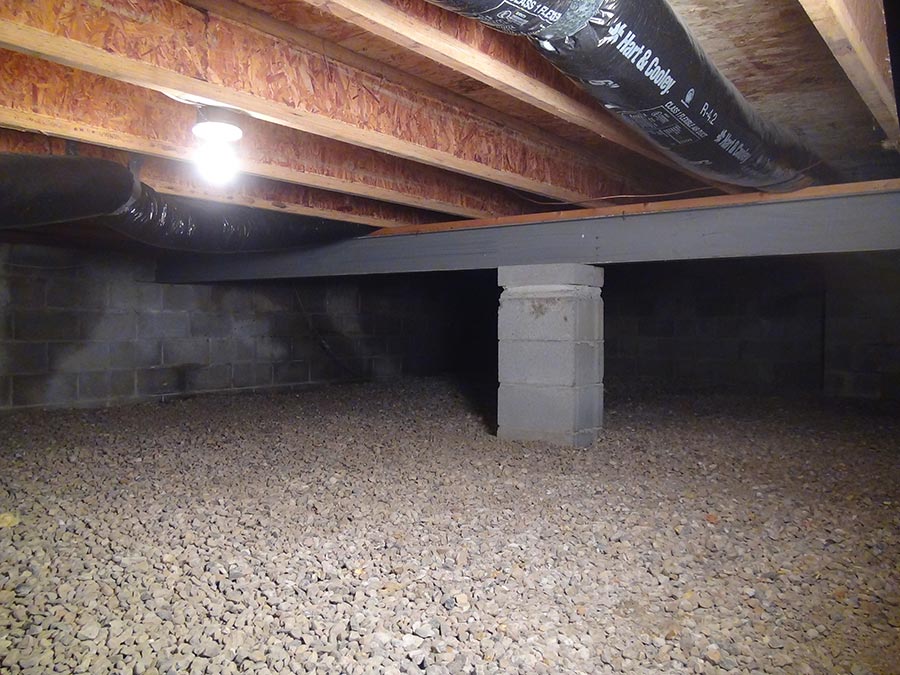
Drainage must be addressed before the barrier is installed. Oftentimes, this means bringing in and leveling a layer of pervious fill.
In 2005, Advanced Free energy conducted a study in Due north Carolina that quantified the advantages of airtight crawlspaces. Homes with liners saved 15% on heating and cooling and were much drier than those with dirt crawlspaces, with average humidity below lxx%. In 2009, they conducted additional tests in Baton Rouge and Flagstaff to see how a sealed crawlspace would perform in extremely humid and extremely dry climates.
"In Baton Rouge, the results were very clear that airtight crawl spaces dramatically affect relative humidity," says Cyrus Dastur, edifice scientist at Avant-garde Free energy. The closed clamber space systems in Louisiana kept crawlspace humidity effectually threescore% (equally opposed to 80% in clay crawlspaces). In Flagstaff's dry climate, even clay crawlspaces had less than 70% humidity, simply the closed clamber spaces were even drier, with levels around 50%.
Energy savings in Flagstaff were dramatic. Closing the crawlspace and adding flooring insulation saved about xx% on wintertime heating and 15% in summer months. The study also showed decreased levels of radon, mold, and other allergens.
Sealing the Space
Mike Trotter, possessor of Trotter Visitor, a Georgia-based waterproofing visitor, says closing crawlspaces is a great style for waterproofing contractors to diversify their businesses. "I believe crawlspaces are a cracking concern to get into," says Trotter. "Most, every crawlspace needs to be closed and lined."
Sealing the crawlspace involves several steps, including endmost off the air vents, sealing the dirt floor, and installing dehumidifiers, insulation, and sometimes a drainage organization. In some instances, mold remediation and/or pest control is as well needed.
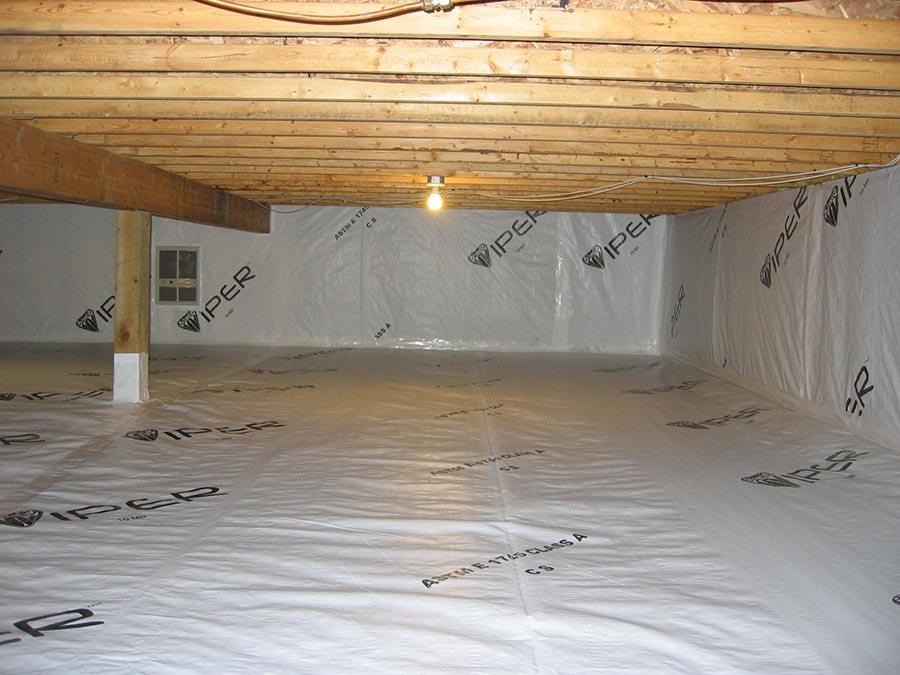
The primal component of the system, though, is sealing off the wet coming through the dirt floor. Is concrete a practiced choice, or is a plastic liner ameliorate?
Concrete
At kickoff glance, pumping concrete into a crawl infinite may seem logical to homeowners. Later all, concrete slabs work well in the garage and basement. Additionally, information technology creates a nice finished look, and provides level, user-friendly storage.
But sealing and insulation experts say it may not be the best choice for air quality.
Ron Greenbaum, owner of Nash Distribution, an Ohio-based waterproofing wholesaler, has sealed hundreds of basements over the years. "Concrete is a good choice in new structure, but information technology's often not a good choice for retrofit applications," he says.
"As long every bit in that location are stable soils, and if it'southward poured properly, it should be fine. The problem is that in retrofit jobs, oftentimes you take very limited infinite and it'due south just difficult to piece of work in, and that affects beingness able to cascade the concrete right. Also, if the soil is contaminated, you'll need a liner. If there are oils or radon in the soil, y'all've got to take something under that concrete."
Cole is adamant that concrete is never a good selection for retrofit jobs. "Choosing moisture, porous physical to seal a crawl-space is like hiring a wolf to baby-sit the chicken coop," says Cole. He claims the h2o in the concrete mix—50 to 75 gallons per cubic m—will add to a domicile'south moisture bug.
"I realized pumping concrete into the clamber infinite was actually a disservice to the homeowner," he says. "Cosmetically it may expect great, just the concrete required for a 1,000 foursquare pes crawlspace with a 4-inch slab contains 500 gallons of water, which will exist entrapped within the floors and walls of the home," he says, "peculiarly if at that place'due south a liner underneath the slab. All that moisture can only escape upward."
Even after the physical is completely cured, Cole says it can proceed to contribute to moisture problems. Without a thermal interruption, the temperature difference between the warm moist air and the common cold concrete surface will cause condensation. And that leads to more mold.
Greenbaum says that the condensation event can exist avoided by insulating under the slab. The Barrier, an insulated underslab moisture bulwark from Northwest Ohio Foam Products, is a perfect solution. It consists of a three/eight" core of flexible EPS foam sandwitches between two 3-mil polyethylene sheets. It combines thermal bulwark, a vapor retarder, and moisture barrier in a single product.
Cole is unconvinced. "A homeowner who agrees to have concrete pumped into a crawl space is unknowingly saturating the entire surface area with mold-friendly wet," he says.
Liners
The alternative to pumping concrete is installing a polyethylene liner or membrane.
The 2005 and 2009 studies cited above demonstrated that the minimum thickness required to stop the moisture is a 6 mil polyethylene liner (one mil is equal to 1/1000 of an inch.)
Most crawspace liners look the aforementioned. They're usually string-reinforced white polyethylene. Dario Lamberti, production manager at Insulation Solutions says well-nigh customers adopt white because it offers a make clean, aesthetically-pleasing space. "If they're using it for storage, or even go downwards at that place at all, they're going to put in some lighting, and that white liner makes information technology look so much more appealing," he says. "Information technology really cleans it up."
Tom Saucier, owner of Crawlspace Doctor in central Indiana, says that while a 6-mil bulwark is adequate, thicker is ofttimes better. Most normally a 12- to 20- mil product is used, simply liners up to 90 mils thick are available. It depends on how much utilise the crawlspace is going to run into. "If installed properly any liner is going to work," Saucier says. "The question you lot accept to ask is 'How are you going to use the infinite after it is finished? Practice you ever want to see it again?"
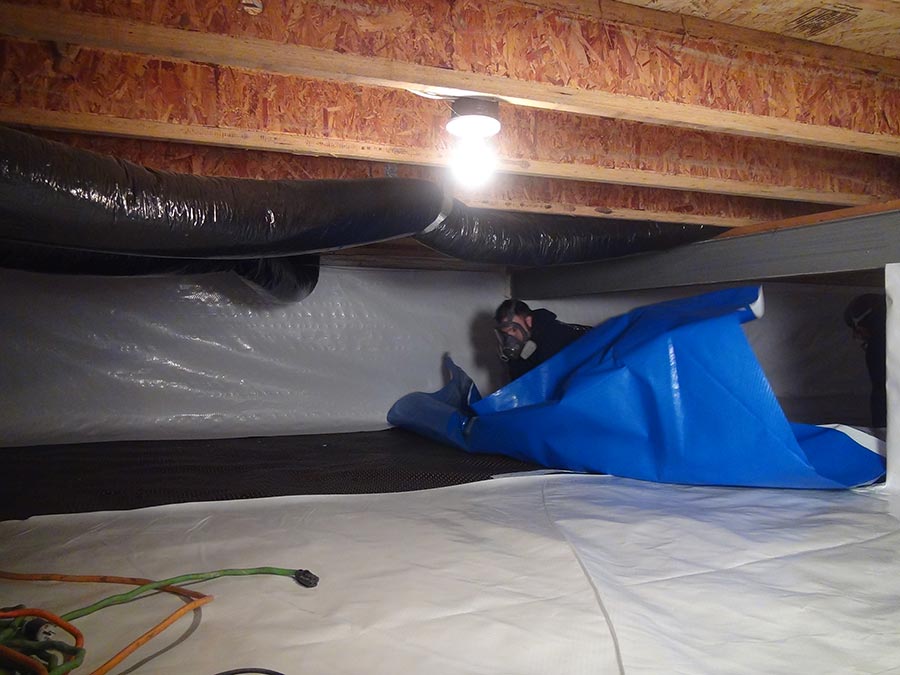
Thicker membranes are more durable, but some of them tin be difficult to install, peculiarly if the crawlspace is tight or has multiple piers.
Saucier says, "A 10-mil liner will go along out the wet just the same every bit a 20-mil liner as long equally it is installed properly and it volition be cheaper for the customer."
Greenbaum explains, "Thicker liners are a little harder to install around piers. Some of the heavier ones feel similar you're laying carpet. So if at that place isn't going to exist any storage, a thinner 10-mil bulwark is good enough".
On the other paw, if the crawlspace is relatively spacious with outside access,. homeowners will frequently use the surface area for storing boxes and other items. (Trotter, the Georgia waterproofer, met ane customer who had five canoes stored in his crawlspace.)
Greenbaum says that most of his clients in the upper Midwest practice plan on using the infinite to some degree, so he usually installs a thicker 20-mil barrier. "Whatsoever thickness you choose," he says, "make sure it's inorganic—and then mold won't grow, and puncture proof."
Lamberti says insulation Solutions makes a cross-woven, reinforced x-mil liner that can stand upward to significant abuse. "It is available in other thicknesses," he says, "Notwithstanding, because of the crosswoven reinforcement, it's going to have equivalent force characteristics to college millage products."
Every barrier manufacturer prepares a spec sheet for their products—information technology's usually available online—which the installer tin can use to verify the liner is anti-microbial and fire-retardant.
In any instance, the barrier should at a minimum:
- Permanently seal the floor
- Exist treated for mold and mildew resistance
- Be like shooting fish in a barrel to detail around piers and wall edges
- Be capable of stopping radon and other natural gasses in the soil
The Next Step
As noted earlier, sealing the floor of the crawlspace is only ane office of closing the crawlspace. Greenbaum notes that if concrete h2o is present, a drainage organization is mandatory, and must be installed before the liner. Often, he installs a sump pump in the lowest area of the space.
"Likewise, I always recommend dehumidification," he says. "Make sure the system is big enough to take care of the square footage and nonetheless be efficient. You don't want it to accept to run all day long."
Cole adds, "In sealing crawlspaces, it'due south of import that nosotros do it right. We tin can take the like shooting fish in a barrel way out, or we can take a more than educated arroyo. A little educational activity can save lives."
Source: https://www.waterproofmag.com/2012/04/sealed-crawlspaces-concrete-vs-plastic/
0 Response to "White Cap the Kind That Is Put in Crawl Spaces What Are the Reviews on It"
Post a Comment