Where Is My Quickbooks 2019 Upload File
QuickBooks Changes
For some reason – no ane seems to know – Intuit significantly inverse how QuickBooks 2019 and newer versions import IIF files.
Past default, the new import procedure appears to take the IIF file and endeavour to procedure information technology through the same code that the COM/SDK uses to validate information for import. This imposes many more rules and restrictions in an attempt to ensure… something. We are not sure what. Unfortunately, this new error-checking imposes unneeded restrictions and carries with it many omissions and bugs – all unhelpful and some dissentious to your information.
There are many new issues which actually stop QuickBooks from importing normal and valid IIF files – files that take e'er worked and go along to work in older versions of QuickBooks. As a upshot, IIF files that used to work won't anymore – by default. There are also issues where data in the IIF file is ignored and not imported and also where QuickBooks records something completely unlike than is in the IIF file.
Nosotros've released updates to our products to compensate for the most debilitating of these errors.
Still, in that location are remaining issues you may see unless you lot follow these recommendations:
Import Options Overview
Newer versions of QuickBooks now offering two ways to import: These are the new default method and the older method, that you may take used with older QuickBooks versions – which continues to work appropriately.
This second and recommended method is subconscious behind a weirdly named link that sounds sort of scary. Ignore that. Information technology'south nonsense!
The two options highlighted:
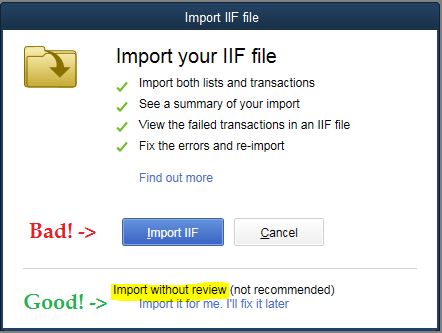
Bad: The Import IIF button imports using the new and buggy method.
Good: The misleading Import Without Review, Import it for me link, which uses the stable lawmaking we've all been using with IIF files for 20+ years. IIF files piece of work best using this choice!
Recommendations
a. Use the Import without review – Import it for me option!
- This option uses the more reliable and more accurate and stable IIF import code. It is the same equally older versions of QuickBooks.
- The weird "Import information technology for me. I'll fix it later" label suggests you'll have to fix something, but that simply incorrect. (It's more likely you'll need to fix something when importing using the new way.)
b. For our customers, download and install the latest builds of our products:
- Upgrade to the Latest Product Builds – (free!)
The latest builds volition create IIF files that are a little unlike than older builds and will work amend with newer QuickBooks versions.
If you use the new/default Import IIF option (non recommended!)
- Y'all may be blocked during your import attempt by issues that are not really issues.
- One of the known bugs may impact the import results.
- Import will be 10 – 20 times slower.
Known bugs using the new/default IIF import method
These are some of the new restrictions & bugs, most of which are avoided when using the recommended method above.
- When importing time records, QuickBooks may issue errors that indicate that the related employee address is invalid – even though you are not importing changes to the employee.
- When importing fourth dimension records, if yous haven't explicitly toggled the "use time for payroll" checkbox on an employee, go bogus error bulletin that you take to, and to "Have your application ask the user whether or not to set time tracking for this employee." In this context "your application" is QuickBooks, and and then that's non possible.
- When importing fourth dimension records, import volition fail if the class field values are not dates – merely the class list is not a list of dates!
- The Transport Later (electronic mail later on) status for sales forms is ignored.
- It won't import 0.00 amount invoices (and perhaps other sales) even if the details of the invoice are non-zero.
- Document numbers are incorrectly express to 12 characters though much larger values are actually allowed in QuickBooks.
- Phone numbers on name records are incorrectly express in length which will oftentimes cause the extension to be omitted – while much longer values are really accustomed in QuickBooks.
- If you include a semi-colon (;) in a text field in the IIF file, QuickBooks stops reading the line at the semi-colon. If there are required fields after that, the import fails. If optional fields, then they are not imported and y'all will lose data.
- If you include any characters with a ASCII value a little larger than a tilde (~) QuickBooks imports it as a "?" character.
- Characters include "€‚ƒ„…†‡ˆ‰Š‹ŒŽ''""•–—˜™š›œžŸ ¡¢£¤¥¦§¨©ª«¬®¯°±²³´µ¶·¸¹º»¼½¾¿ÀÁÂÃÄÅÆÇÈÉÊËÌÍÎÏÐÑÒÓÔÕÖ×ØÙÚÛÜÝÞßàáâãäåæçèéêëìíîïðñòóôõö÷øùúûüýþÿ"
- Likewise college-finish characters beyond this range.
- And then names and other text with European/international characters not import correctly. For example, René Cresté will import as "Ren? Crest?".
- The reconciled status is ignored during import. All transactions are imported as uncleared, which completely defeats the use of the field.
- Even though the reconciled condition is ignored and not recorded, QB still checks the values and will cake the entire import if there is a single reconciled condition other than Y or N or empty. But the IIF file format and QuickBooks both support a tertiary status, "newly cleared", the "*" you can see in the register, which is represented in IIF using a tertiary graphic symbol.
- Import fails if yous omit the customer on sales receipt transactions. But at the aforementioned fourth dimension QB does non require a customer on sales receipt transactions. Y'all tin can record them without a proper noun, which is usually done when importing daily sales transactions.
- When importing employees with perfectly formatted addresses – they are trashed: The Urban center, State, ZIP fields are duplicated and entered in the second street address field.
- Upkeep records will not import – QuickBooks gives an mistake: "It's a listing or transaction that is not supported by the IIF import process." Which is of course wrong. Budgets ARE supported.
- When importing Group items and their details on sales transactions, QuickBooks ignores the contents of the IIF file and just applies the grouping as it exists on your items list. So, if you have customized the contents of the group, changed the amounts or the items included, all of that data is ignored.
- Detail lines on General Periodical transactions are resorted as the Journals are imported instead of remaining in the order specified in the IIF file.
- New line characters ( '\n' ) in memo fields are not candy. The memos become one big long blob of text instead.
There are many more issues – we gave upwardly documenting them all…
Issues that may be fixed in some QB versions:
- When importing a check with no check number (since it is non really a check, for example, but a debit charge) QuickBooks assigns a check number anyway.
- QuickBooks will not import opposite/credit lines on transactions. For instance, you can't import a return line item on an invoice, a line that reduces the invoice full.
Source: https://bigredconsulting.com/quickbooks-2019-iif-import/
0 Response to "Where Is My Quickbooks 2019 Upload File"
Post a Comment